1-Day English Immersion in Fujieda – Domestic Study Abroad
The 1-Day Domestic Study Abroad
Spend eight hours thinking in English — without leaving Japan.
Request Dates
Why go overseas when you can immerse yourself in Fujieda?
You don't need a passport to spend a whole day working in English. The Domestic Immersion Intensive is a "Domestic Study Abroad" (Kokunai Ryugaku) experience designed for motivated adults who need a real change.
This is not a standard lesson. It is 8 hours of continuous English immersion from 9:00 AM to 5:00 PM, limited to one student per day.
If you've studied for years but still struggle to feel confident speaking, this day is designed to break that pattern and prove—to yourself—that you can function in English.
Whether you are an executive preparing for an overseas trip, a professional exploring how to use AI in your work, or a senior learner wanting to challenge yourself and rebuild confidence, this experience is built around you.
Course Highlights
- Immersive English Environment: From the moment you step in, English becomes the default language. If you slip into Japanese, there's no penalty — I'll ask how you'd say it in English and let you try first. Staying in English is the challenge; discovering that failing at it costs you nothing is part of the design.
- Authentic Home Environment: Practice English in a real home. The kitchen becomes your language lab during the cooking session, and lessons take place in a washitsu converted into a home classroom — large shared table, shoji screens, whiteboard, and monitor — a calm, focused space for one-on-one learning.
- Personalized Curriculum: No generic textbooks. Materials are built around your mistakes, patterns, and goals.
- Deep Consolidation: The course uses science-backed spaced repetition to ensure what you learn actually sticks.
- Day-Trip Program (No Lodging): A full-day intensive designed as a day trip — no overnight accommodation provided. Guests traveling from outside Fujieda are welcome to book a nearby hotel at their own arrangement.
Why Private Immersion?
Most “English Camps” place you in a group of 5–10 students. Even if you attend all day, your actual speaking time may total only 20–30 minutes.
In this private immersion structure, the entire 8 hours belongs to you. There is no competition for attention, no waiting your turn.
| Feature | Typical Group Camp | Private Immersion |
|---|---|---|
| Speaking Time | Low (Shared with others) | 100% (All You) |
| Curriculum | Fixed / Generic | Built for Your Goals, Level & Patterns |
| Pace | Must match the group | Adjusted to Your Brain |
| Teacher Attention | Divided | 100% Focused on You |
The Day-Trip, One-on-One Way to Do Domestic Immersion
Most "domestic study abroad" (国内留学) in Japan is a 2–7 night residential group camp—boarding schools near Mt. Fuji, two-day boot camps in Tokyo, and the like. If you want to move in and immerse for several days, those are a great fit.
The Fujieda 1-Day Domestic Immersion offers a different path: a single day, one-on-one, and home the same evening. Because it's a day trip, you can reach near-study-abroad intensity using a single day of leave.
| Feature | Residential / Group Camp (typical domestic study abroad) |
Fujieda 1-Day Immersion |
|---|---|---|
| Format | 2–7 nights, overnight stay | Day trip (no lodging) |
| Time off needed | Several days to a week | Just one day |
| Lesson format | Group (5–10 students) | Fully one-on-one |
| Materials | Shared curriculum | Built for you, that day |
| Typical cost | ~¥100,000+ for two days | ¥48,000 for the day (founding price) |
| Location | Mostly distant camp facilities | Fujieda · free parking |
Here, all 8 hours are yours, with one consistent teacher for the entire day. The stumbles we spot in your morning conversation become your afternoon materials, because the same person remembers them. It's a right-sized entry point for an adult who wants to try one focused day, as a day trip, before committing to anything longer.
Sample Itinerary (09:00 – 17:00)
Activities are deliberately designed to alternate between high-output speaking and quiet consolidation, preventing burnout while maximizing retention. Every task forces real-time listening, response, and recall.
| Time | Activity | Description |
|---|---|---|
| 09:00–09:30 | Orientation & Warm-up | Warming up in English and setting your goals for the day. |
| 09:30–10:30 | Session 1: Discovery & Diagnostic | Extended diagnostic conversation to identify your personal error patterns, gaps, and communication style. |
| 10:30–10:45 | Break | Short break to reset. |
| 10:45–11:45 | Session 2: First Training Block | Targeted work on the patterns identified in Session 1 — pronunciation, grammar in context, vocabulary building. |
| 11:45–12:30 | Cooking Lunch | I guide each step in English while you cook — recipes, measuring, describing, deciding on the fly. Kitchen-first, not a textbook exercise. |
| 12:30–13:15 | Lunch & Conversation | Casual conversation while eating. Low-pressure, natural output. |
| 13:15–14:15 | Session 3: Focused Training | Pronunciation and listening training inspired by the Fluent Forever approach (using the concept of "thinking in English" to build reflexes). |
| 14:15–14:30 | Break | Tea break. |
| 14:30–15:15 | Deep Consolidation | Quiet, focused review. You work independently on personalized review tasks covering everything from the morning and early afternoon — active retrieval, self-explanation, and written reflection. (All materials are prepared before you arrive.) |
| 15:15–16:15 | Session 4: Real-World Simulation | Communicative games, photo description, or practical tasks — applying what you consolidated to real situations, developing your ability to think and respond without translation. |
| 16:15–16:45 | Review, Roadmap & Reflection | Key takeaways, vocabulary review, and a clear plan for continued self-study. Calm reflection over tea. |
| 16:45–17:00 | Wrap-up & Dismissal | End of the program. |
At the End of the Day
What You'll Feel
- Mentally tired, but calm (good tired, like after a long walk)
- Accomplished without pressure
- Satisfied that you used English for 8 hours without embarrassment
What Makes It Different
- You progress at your own pace
- A day that values your sense of accomplishment
- Your own unique learning experience
The Kind of Tired
Your brain will feel full, but you won't feel drained or anxious. Just satisfied. (And well-fed.)
Investment
All prices include tax.
This intensive program is a serious investment in your English, with value standard lessons can't match:
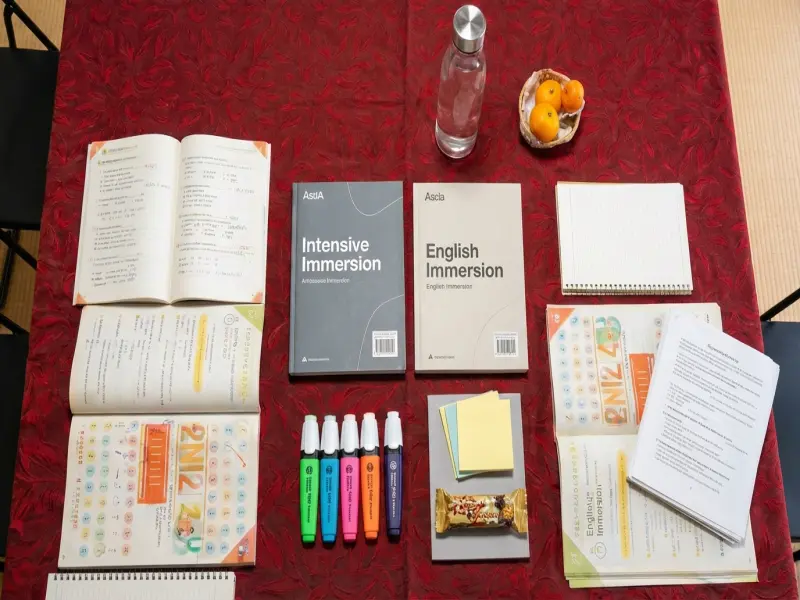
- 8 hours of continuous English exposure: A "Japanese-light" immersion environment.
- Fully customized materials: Built from your real language patterns.
- Science-backed learning design: Focused on long-term retention.
- Real-world application: English used in meaningful contexts.
- Exclusive one-on-one coaching: My entire day is reserved for you.
- Entrance Fee: ¥0 (Waived for immersion programs)
- Materials: Included (Personalized curriculum and materials for the day).
- Take-home review plan: Leave with a personalized study roadmap and review system you can continue at home.
Eight hours is roughly ten weeks' worth of contact time from a weekly 50-minute lesson — delivered in one continuous stretch, which a weekly schedule cannot reproduce.
Standard Price: ¥75,000 Founding Participant Price: ¥48,000
*Founding Participant Price (includes a short feedback interview after your immersion day).
*One student per day—and only a limited number of days per month—to protect quality.
*Payment is made in cash on the morning of the program. (A receipt will be provided.)
Ready to challenge yourself?
Availability is extremely limited (one student per day). Feeling nervous about 8 hours of English is natural—that's exactly why I designed the schedule to alternate between active speaking and quiet focus time. The structure proves to you that you can do this.
Need more than a day? Extended immersions (e.g., a Sunday + Monday pair) are available on request for applicants with deeper goals. The standard offering remains a one-day program. Just mention the extended-format interest in your application.
Why trust this program?
- 36 years in Japan: I understand Japanese, so I know exactly where Japanese speakers get stuck — and I can get you unstuck without switching languages.
- Designed for busy adults: Building confidence and speaking under pressure.
- Tailored to You: Materials built from your specific error patterns.
This application helps me design your day before we confirm dates.
Frequently Asked Questions
Q. My English is very poor. Can I really handle 8 hours?
A. Yes! This is a completely private (1-on-1) course, so I adjust the speed and vocabulary 100% to your level. If you're a beginner, I'll speak slowly and use simple words. You don't need to be advanced—you just need to be willing to try.
Q. Won't I get exhausted halfway through?
A. It's demanding, but the schedule is designed to prevent brain fatigue. After lunch, the "Deep Consolidation" session is 45 minutes of quiet, focused review. You work independently with material from the day so far — no forced conversation, just active reflection at your own pace.
Q. I'm not good at cooking. Is the cooking session mandatory?
A. Don't worry! If you enjoy cooking, we can try a new recipe together. If you prefer something simple, we can make sandwiches or pasta. The goal is "using English in the kitchen," not culinary perfection. I'll adjust to your interests and comfort level!
Q. Is Japanese really completely forbidden?
A. No. The challenge is to get through the whole day in English, and that's where most of the value is — but if you fall back into Japanese, nothing bad happens. I won't penalise you, and I won't just move on either. I'll ask how you might say that same thing in English, and let you try it yourself first. You might not manage it, and that's fine too: finding out that failing to reach a word costs you nothing is one of the things this day is for. Then we work it out together and carry on.
For my part, I stay in English essentially the whole day. I'll switch only if something genuinely can't be resolved any other way.
This is deliberately stricter than my weekly lessons. In a 50-minute lesson, switching to Japanese is often the fastest way to answer a question, so I do it. Eight hours is long enough that staying in English becomes realistic — and that's the point of the day.
Q. Can I stay overnight?
A. No, my house does not have lodging permits, so overnight stays are not possible. If you're traveling from far away, please book your own accommodation near Fujieda Station.
Q. Do you handle dietary restrictions or allergies?
A. Yes. Please let me know in advance, and we will plan lunch accordingly.
Q. What payment methods do you accept?
A. Payment is made in cash on the morning of the program.
Q. Can I cancel or reschedule?
A. Life happens—sudden illness or schedule conflicts are normal. If something comes up, just contact me right away. Rather than charging cancellation fees, I prioritize rescheduling to a different date. Please let me know by the day before if possible, so I can adjust preparation.
Q. Is there parking?
A. Yes! There's free parking on-site (4 spaces), so you can drive.
Q. What should I bring on the day?
A. Bring writing materials, and if you have a laptop, please bring it for setting up your review system (smartphones or tablets also work).
*Note: The learning app "Anki" is free on Android/PC/Mac; the official iPhone app is a paid download (¥4,000). iPhone users can use the free AnkiWeb site instead. Or I can show you how to build a Leitner box — a physical flashcard system that does the same job without any app.
Want to Learn More?
Curious about the science and methodology behind this program? These articles explain the key concepts:
- Why We Forget What We Study — The forgetting curve and spaced repetition science
- What Happens in Your Brain During 8 Hours of Immersion — The science of intensive learning
- The Science of Deep Consolidation — Why quiet focus time strengthens memory
- Stop Translating. Start Thinking in English. — How to link English straight to meaning
- Why "Studying Hard" Is the Wrong Strategy — Building efficient learning systems