Stop Reading. Start Writing: Two Study Methods for the Eiken Speaking Test
The usual way to get ready for the Eiken speaking test is to read your notes. That is a reasonable place to start. A second pass over the notes does real work — it fills gaps, and it corrects things that were half-remembered wrong.
But it stops paying off much earlier than it feels like it does. Rereading makes a passage familiar, and familiarity in the moment feels exactly like knowing. Researchers call this the fluency illusion: the growing ease of moving your eye over the same page creates a sense of competence that does not match what the brain has actually stored.
In the interview room that gap has a price. Each answer in the Grade 3 test is graded out of five, and the picture questions are the ones a one-word reply cannot survive — “Two” instead of “There are two cups” is marked down. Recognising a correct sentence on a page and producing one out loud are different skills, and only the second one is being tested. A student can revise for weeks, feel ready, and still lose marks on questions they understood perfectly.
There are two methods that train the second skill, and both have published backing. Neither is new and neither is mine — learning science has known about them for decades. What they rarely get is a worked example against a Grade 3 picture card, which is what the rest of this post is.
Free recall: close the book and write
Take a blank sheet of paper. Set a timer for ten minutes. Write down everything you can remember about a passage you have just studied — names, dates, sentences, the shape of the argument. Do not look at the source. The source is closed.
When the timer rings, open the source and compare. The next ten minutes are the most useful part of the exercise: you see what you actually know, and you see what you thought you knew but did not.
This is what does the work. The brain strengthens the memory it had to fight to retrieve. The comparison tells the student what to study next.
Researchers call this the testing effect. A 2017 review gathered 118 studies covering 15,000 students, and testing yourself came out ahead of every other study method in it.
A classroom study at the University of Washington shows the size of the gap. In one physiology course, students took short quizzes on some of the material and reread the rest three times. On the final exam, the quizzed material averaged A−. The reread material averaged C+. One course, one cohort, two ways of studying. The difference was what the brain did with the effort — pull the answer out, or let it slide past.
The harder the brain works to pull a memory out, the stronger that memory becomes afterwards. Easy retrieval teaches the brain very little.
There is also a strong Japanese context for this — the curve of how fast we forget vocabulary makes plain why rereading alone is a losing strategy.
Reformulation: write yours, then compare
Write your own draft of something — a sentence, a paragraph, an answer to a practice question. Then look at a model version, written by someone who already knows what they are doing. Compare the two. Notice what you got, what you missed, what you had that the model skipped.
This is not a new idea. It was first written up in 1982. In one study, seventh-grade students compared their own writing against a version written by a native speaker, and 80% of the changes they made afterwards were correct.
That study was about writing. I use the same step for speaking, because the comparing is what does the work either way. And when researchers looked at correcting people’s speech, students who were pushed to find and fix their own mistake improved more than students who were simply handed the right answer.
You cannot fix a mistake you have not noticed. That is what the comparison is for — it shows you the gap, and the gap is the lesson.
This is the same principle behind good flashcard design — the card is the comparison, the gap is the answer.
The worked example: one picture, four boxes
Here is what this looks like with one picture, one sheet of paper, and one prompt you can run today.
Look at the picture below. Before you read anything else, write down what you see. Five short sentences. Present tense. A1 vocabulary. One piece of information per sentence. Group them in this order: people, what they are holding or doing, objects around them, background.
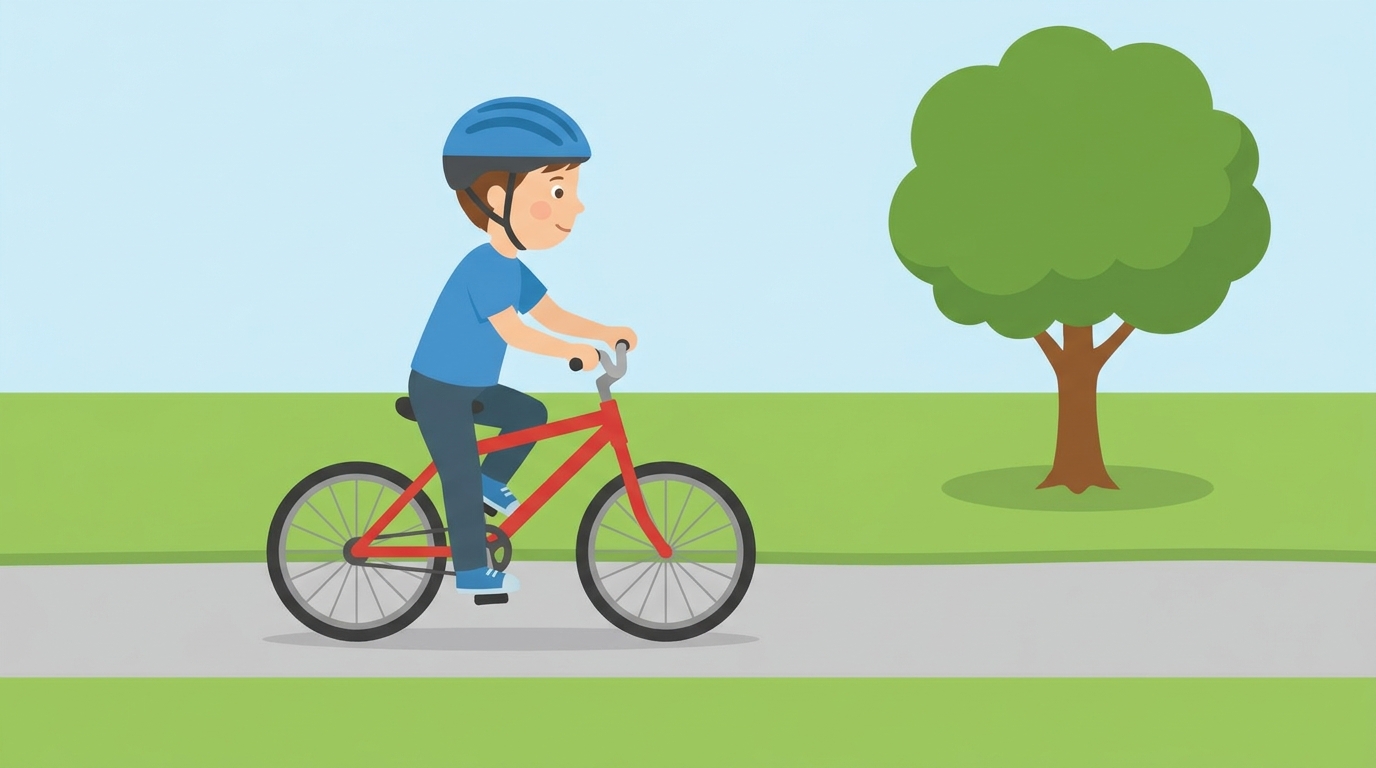
When you have written your sentences — on paper, not on a screen — open the boxes one at a time, in order. After each box, close it again and try the next.
Box 1 — The people
- There is a boy here.
- A boy is in the picture.
- He is a young boy.
- He has a blue helmet.
- He has short brown hair.
- His face is round.
- He has two eyes.
- He has a small nose.
- He has a small mouth.
- He is wearing a blue shirt.
- He has dark blue pants.
- He is wearing blue shoes.
Box 2 — What he is holding or doing
- The boy is smiling now.
- He has a red bike.
- The bike has two wheels.
- The boy is riding a bike.
- He is holding the handlebars.
- His hands are on the bike.
- His feet are on the pedals.
- He is looking straight ahead.
- He is looking down the path.
- He is riding very well.
- The bike is under him.
Box 3 — Objects around him
- The bicycle is bright red.
- The wheels are black and gray.
- The wheels are big.
- There is a green tree.
- The tree is on the right.
- The tree has green leaves.
- The tree has a brown trunk.
- There is a gray path.
- The boy is on the path.
- There is green grass here.
- The grass is near the path.
- The grass is behind the path.
Box 4 — The background
- The sky is light blue.
- There are no clouds today.
- The grass is very green.
- There is a big tree.
- There is a green field.
- The field is behind the boy.
- The tree is behind the path.
- The path is in front.
- The boy is near the tree.
- The tree is very big.
- There is a shadow under the tree.
- The background is very simple.
- It is a nice sunny day.
Your sentences will not match these. That is the point. The comparison tells you what you noticed, what you skipped, what you described differently. Each closed box is another chance to look at the picture again with the next lens.
Two rules before you use the prompt
The model sentences in the boxes above can be produced today, on demand, by any AI chat service that accepts a photo. There is a prompt you can copy and paste:
Look at this photo and write as many CEFR A1-level English sentences
as you can.

Conditions:
- Keep each sentence short, around 5 to 8 words.
- Use present tense (is / has / are / is ~ing).
- Keep the grammar simple (There is ~ / There are ~ / He is ~ing / She has ~).
- Do not use difficult or abstract words.
- One piece of information per sentence.
- Do not use hedging words like "seem," "probably," or "appears to be."

Verb rule (important):
- Verbs describing what the person is doing or wearing must always be in
  the is/are ~ing form (wear, hold, look, stand, sit, smile, point, etc.).
- Verbs describing possession or fixed traits stay in simple present
  (have, has, is/are + color/material/noun).

Output format (important):
Split the sentences into these four groups, with a bold heading before
each group:

**People**
(sentences about the person's appearance and clothing)

**Actions and objects held**
(sentences about what the person is doing or holding)

**Objects nearby**
(sentences about objects near the person)

**Background**
(sentences about the room, weather, or things farther away)

Keep the numbering continuous across all four groups — do not restart
the numbering for each group.

Final check (for every sentence):
1. Is this actually in the photo? (Check colors, what the person is
   holding, and where they are looking.)
2. Is the grammar at A1 level?
3. Is the vocabulary appropriate for an A1 learner?
4. Does it read naturally?
5. Are action/clothing verbs in the is/are ~ing form? (wear → is
   wearing, hold → is holding, look → is looking, etc.)

Do not include any sentence that fails one of these five checks.
Two rules about this prompt.
The first is about who runs it. Students under 18 do not run this themselves. A parent runs the prompt and gives the student the printed result. That is what the AI services’ own terms of service require.
The second is about which photos are safe to upload. Stock photos, your own photos of objects and places, or photos from a textbook you own are safe. Photos of people you know, any face you can name, school worksheets, or anything with a name visible in the frame are not. Treat an upload like posting to social media — would you post this picture?
Why paper, not a screen
A screen invites peeking. The blank paper does not. The whole method depends on closing the source first and writing what the brain actually has, with the model hidden behind four closed boxes. A screen with the answer one tap away is not the same exercise.
How this maps to the Eiken speaking test
The Grade 3 Eiken interview is five questions plus a reading-aloud section, about five minutes in total.
The first three questions come from a card. The examiner hands over a card carrying a short passage and an illustration, and asks the student to read the passage aloud — that reading is graded on pronunciation and phrasing. Then comes a comprehension question about the passage, then two questions about the picture: what someone is going to do (Grade 3 targets “be going to”) and how many of something is on the table (Grade 3 targets “There is / There are”).
After the third question the card is turned over. Questions four and five are about the student rather than the card, and they change from session to session. In the official sample paper they are what the student likes to do on weekends, then whether they have ever been to a foreign country — a yes or no, followed by a question that depends on which one they said. Those two are examples of the shape, not the questions anyone will actually be asked.
Each answer is graded out of five. On the picture questions, a one-word reply loses marks, because the test measures whether the student can produce a complete sentence in English, in the room, on the day. Reading example sentences in advance is not the same as producing them.
Both halves of the method apply directly. Free recall on a Grade 3 picture card before looking at the model sentences is one half. Reformulation against the printed model is the other half. If you want someone to practise the interview with, that is what the Eiken course is for.
The 2024 Eiken revision changed the written portions of Grade 3. The speaking test stayed exactly the same.
The order is fixed
Paper first. Then the prompt. Then the comparison. Never the other order.
Reading the model sentences first is the fluency illusion again. Every sentence looks obvious once you have read it. The student feels they already know them, and encodes nothing. The order is what makes the method work.
Pair the two halves with spaced repetition over the long term, and you have a study system that survives the gap between now and the test date.
A note on where this comes from
This method is not mine. It is not new.
Benjamin Franklin described a version of it in his autobiography. He was an American of the 1700s, one of the founders of the United States, a self-taught writer and inventor who left school at about ten years old. He would read an essay he admired, jot down a word or two for each sentence as hints, then try to reconstruct the argument using his own logic. Then he compared his version against the original to see where his reasoning fell short. Four steps: read, jot, reconstruct, compare.
A man with almost no schooling used this to teach himself to write. If a student thinks they are bad at English, that is exactly who it worked for.